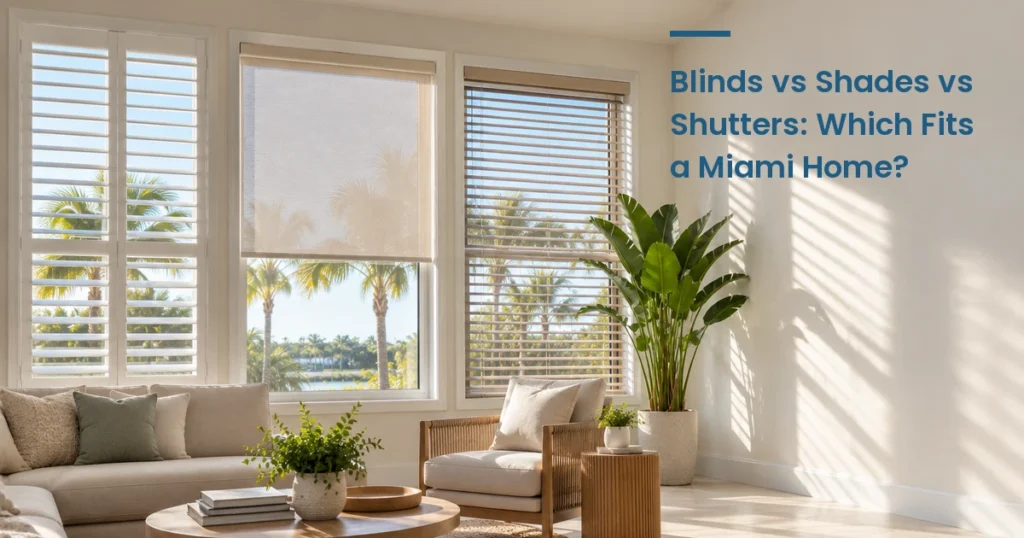
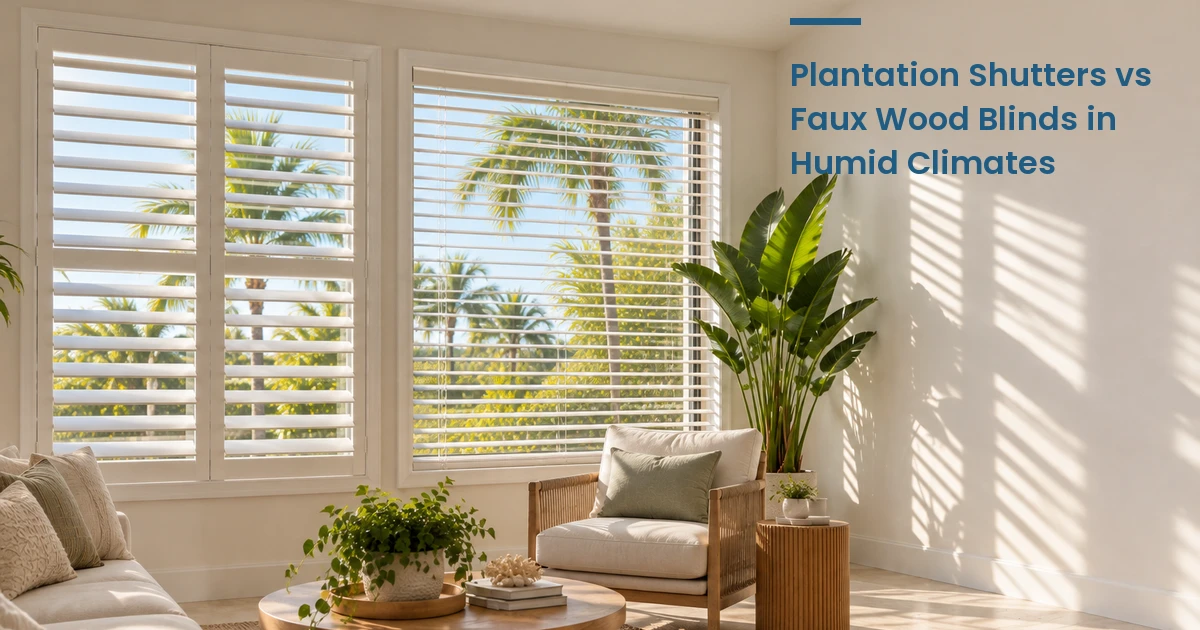
Plantation shutters are solid, built-in panels with wide louvers, while faux wood blinds are lighter slats that hang from a headrail. In humid climates like Miami, both resist moisture well, but shutters tend to last longer and read as a permanent feature. Faux wood blinds cost less and install faster. Palace Interior Design, Inc. builds both across South Florida.
- Plantation shutters are solid frames with wide louvers built into the window, while faux wood blinds are individual slats that hang from a headrail.
- Both resist moisture better than real wood, but shutters generally outlast blinds in steady humidity.
- Shutters cost more upfront and read as a fixed architectural feature, while faux wood blinds are budget-friendly and quick to install.
- Bathrooms, kitchens, and laundry rooms are the spaces where moisture resistance matters most.
- Neither choice is wrong. The right pick depends on your budget, timeline, and how permanent you want the look.
Steam rolls off the shower, the bathroom mirror fogs up, and your window covering sits right in the middle of it every single day. In a Miami-Dade bathroom, that happens more mornings than not.
Real wood doesn’t handle that well. It can swell, crack, or peel within a season. So two materials tend to come up instead: plantation shutters and faux wood blinds.
Both resist moisture. Both look clean. But they’re not the same product, and the differences matter more than they might seem at first glance.
We’ll walk through what each one is, how they perform in a humid room, what they cost to own over time, and which rooms tend to favor which choice. If you want the broader picture first, our guide to custom window treatments in Miami covers all 11 product families we build.
Let’s start with what separates them.
What’s the difference between plantation shutters and faux wood blinds?
Plantation shutters are solid panels with wide, adjustable louvers built permanently into the window frame, similar to a small cabinet door. Faux wood blinds are individual slats made from a synthetic material that mimics wood grain, hung from a headrail like standard blinds. Both resist moisture better than real wood, making them common choices for Miami’s humid climate, though shutters typically cost more and last longer.
What Are Plantation Shutters Made From?
Ever opened a shutter panel like a small door and wondered what’s holding it together? It’s usually one of three materials.
Plantation shutters at Palace Interior come in real wood, composite, or moisture-resistant materials. Each one performs differently in a Hialeah bathroom versus a Coral Gables living room.
| Material | Humidity performance | Best for |
|---|---|---|
| Real wood | Can swell or crack near steady moisture | Dry rooms, formal spaces |
| Composite | Resists warping, handles humidity well | Bathrooms, kitchens, coastal homes |
| Moisture-resistant vinyl or PVC | Built specifically for steam and splashes | High-humidity rooms, pool areas |
Composite and moisture-resistant shutters cost roughly the same as each other, while real wood often runs higher for a similar louver size. In a humid climate, that price difference doesn’t always buy you an advantage. Most plantation shutters use louvers between 2.5 and 4.5 inches wide, and the wider option usually lets in more light per tilt.
Are plantation shutters worth it in a humid climate?
Plantation shutters are often worth it when durability and resale appeal matter more than upfront cost. Composite and moisture-resistant materials handle Miami’s humidity well, unlike real wood, which can swell or warp. They cost more than blinds, but many homeowners treat them as a long-term fixture rather than a temporary covering. Your consultant can help weigh that trade-off against your budget.
How Do Faux Wood Blinds Hold Up in Humidity?
Picture a Kendall kitchen window above the sink, splashed daily and steamed up whenever dinner’s on the stove. That’s exactly the kind of spot faux wood blinds were built for.
Faux wood blinds are made from a synthetic core, often PVC or a composite blend, finished to look like real wood grain. They don’t absorb moisture the way natural wood does, so they hold their shape in a damp room.
- Won’t warp, crack, or peel from steam
- Wipe clean with a damp cloth
- Cost less than real wood or most shutters
- Install faster since they hang from a simple headrail
Lower-grade faux wood can still bend under heavy daily use, so material grade matters as much as the category itself. That’s one reason we bring physical samples to every consultation instead of describing them over the phone. Most faux wood slats run about 2 inches wide, close to the standard size for real wood blinds, so the look translates well even in a bathroom or kitchen.
How long do faux wood blinds last in a humid room?
Faux wood blinds typically last 5 to 10 years in a humid room, depending on material grade and daily use. Lower-grade slats can wear out sooner, especially in a busy bathroom or kitchen. Higher-grade faux wood holds up closer to the longer end of that range. Composite shutters usually outlast blinds, sometimes by a decade or more, since the framed structure takes less daily stress.
Let’s Talk Strategy: Not sure which material fits your bathroom or kitchen? Talk it through with our team at no cost. Book your free in-home consultation
Do Faux Wood Blinds Warp in Humidity Compared to Shutters?
Here’s the question we hear most often at a Doral or Fort Lauderdale consultation. Does one warp less than the other?
Quality faux wood blinds resist warping about as well as composite or moisture-resistant shutters. Both materials are engineered to shed moisture rather than absorb it.
The bigger difference isn’t warping resistance. It’s how the product is built.
- Blinds hang from a headrail, so individual slats can bend under pressure over years of daily use
- Shutters are a rigid, framed panel, so the whole structure resists flexing
- Neither will swell the way real wood can in a steamy room
So if warping alone is your worry, both hold up. If long-term rigidity matters more over 10 or 15 years, shutters usually win.
|
Get a Custom Quote Tell us about your bathroom or kitchen windows and we’ll recommend the right material for the moisture level. |
Which Rooms Actually Need Moisture-Resistant Materials?
Not every window in your Boca Raton home faces the same conditions. Why treat a dry home office the same as a steamy bathroom?
- Bathrooms: highest humidity, daily steam, needs composite shutters or faux wood blinds
- Kitchens: splashes and cooking steam, faux wood blinds are a common, budget-friendly fit
- Laundry rooms: dryer heat and occasional moisture, either material works well
- Living rooms and bedrooms: lower humidity most days, real wood or wood blinds can still make sense here
That’s 4 distinct humidity zones in a typical South Florida home, and treating them the same is where a lot of window coverings fail early.
A Palm Beach County home can mix all four approaches room by room, and that’s normal. For a laundry room or home office, aluminum mini blinds are another budget option worth a look. Your consultant walks through each space during the free in-home visit rather than applying one rule to the whole house.
Plantation Shutters vs Faux Wood Blinds: Which Costs More Over Time?
Upfront price only tells part of the story. What happens 5 or 10 years down the road?
| Factor | Plantation shutters | Faux wood blinds |
|---|---|---|
| Upfront cost | Higher | Lower |
| Installation | Built into the frame, more involved | Simple headrail, faster |
| Expected lifespan | Long, often decades with proper care | Shorter, especially lower-grade material |
| Resale appeal | Reads as a built-in feature | Reads as a removable window treatment |
| Replacement cost | Rare | More likely over time |
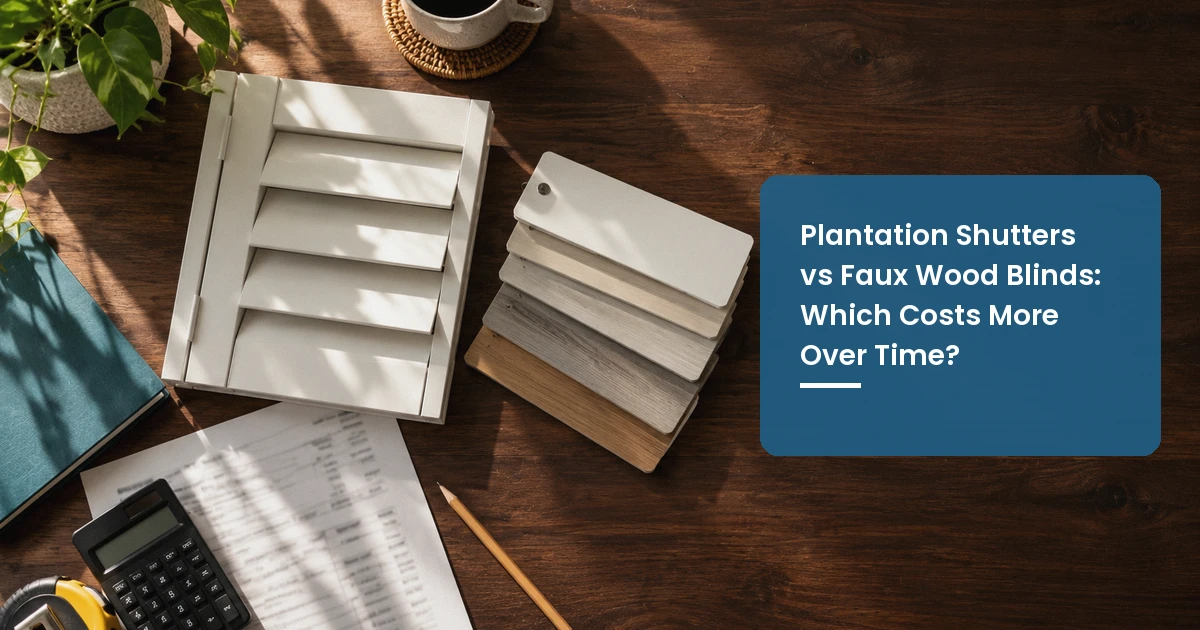
For a South Florida home you’re planning to stay in long-term, shutters can even out over the years. For a rental unit or a room you’ll likely redo later, faux wood blinds keep the door open without locking in a bigger investment. Isn’t it worth weighing both against how long you’ll actually own the home?
Final Thoughts
Plantation shutters and faux wood blinds both solve the same core problem: standing up to Miami’s humidity without warping or peeling. The real difference comes down to structure, cost, and how long you want the product to last. Shutters are the built-in, longer-lasting choice. Faux wood blinds are the flexible, budget-friendly one.
Why does that distinction matter beyond looks? Because picking the wrong fit for a steamy bathroom means replacing it sooner than you’d like, in Miami and across the United States alike.
Walk through your home and note which rooms face daily steam or splashes. That’s where the material choice matters most.
Palace Interior Design, Inc. has built and installed plantation shutters and faux wood blinds across Miami-Dade, Broward, and Palm Beach Counties for more than two decades.
Ready to compare samples of both in your own home? Schedule your free in-home consultation or call 1 (866) 488-7205. You can also browse our full product range before your visit.