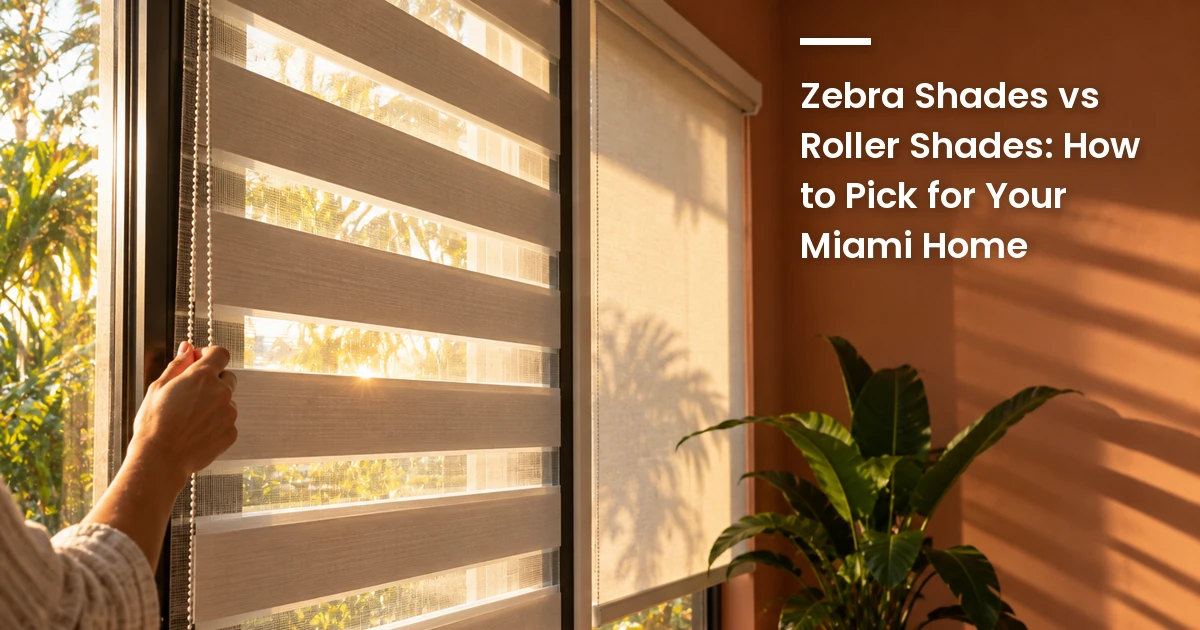
Zebra shades use alternating sheer and solid fabric bands you can adjust for filtered light, while roller shades use one continuous piece of fabric you raise or lower. In Miami, zebra shades give more flexible daytime privacy, while roller shades offer simpler operation and a cleaner look. Palace Interior Design, Inc. builds both across South Florida.
- Zebra shades use two layered fabric bands you slide to control light, while roller shades use a single fabric piece you raise and lower.
- Zebra shades let you keep some privacy and view at the same time, even at midday.
- Roller shades come in light-filtering, solar, or blackout fabric, so the fabric itself sets the light level.
- Neither fully blocks 100 percent of light at the edges, though blackout roller fabric comes closest.
- Both suit sliding glass doors and bright rooms, but they solve slightly different problems.
The TV glare hits right around 4 p.m. in a lot of Aventura living rooms, and closing the blinds all the way just trades one problem for another: a dark room. That’s usually the moment someone starts comparing zebra shades and roller shades.
Both are modern, cordless-friendly options. Both cut glare. But they work in different ways, and picking the wrong one means living with a room that’s either too bright or too dim more often than you’d like.
What’s the difference between zebra shades and roller shades?
Zebra shades use two layered fabric bands, one sheer and one solid, that slide against each other so you can adjust how much light comes through while the shade stays lowered. Roller shades use a single piece of fabric that wraps around a tube and raises or lowers as one unit. Both are common in Miami homes for their clean look and glare control, but zebra shades give more adjustable privacy at midday.
How Do Zebra Shades Actually Work?
Ever wanted a shade that lets in daylight without anyone seeing straight into your living room? That’s the problem zebra shades solve.
Zebra shades, sometimes called dual or banded shades, use two fabric layers, sheer and solid, stitched into alternating horizontal bands. Sliding the layers over each other lets you dial in exactly how much light and visibility you want, without raising or lowering the shade.
- Fully aligned sheer bands: soft, filtered daylight
- Fully aligned solid bands: closer to room-darkening
- Anywhere in between: adjustable privacy through the day
In a Weston home office, that middle setting matters most. You get enough daylight to work by without a washed-out screen or a glaring window behind you on video calls. Most zebra shade fabrics offer roughly 3 to 4 practical stopping points between fully open and fully closed, even though the slide itself is continuous.
Do zebra shades give privacy during the day?
Zebra shades give adjustable daytime privacy by sliding the solid fabric band to cover the sheer layer as much or as little as you want. At full overlap, they block most direct sightlines while still allowing filtered light through. They’re not a full blackout option at the edges, so nighttime privacy usually calls for a denser fabric or a second layer. Your consultant can show you fabric samples to compare light levels in person.
|
Let’s Talk Strategy: Not sure if zebra shades fit your room’s light? Talk it through with our team at no cost. |
How Do Roller Shades Work, and What Fabrics Are Available?
Picture a Pinecrest sunroom with three walls of glass and afternoon sun pouring in every day. That’s a classic roller shade situation.
Roller shades use a single fabric panel that wraps around a tube mounted above the window. A chain, spring system, or motor raises and lowers the whole shade in one motion, and the fabric itself decides how much light gets through.
| Fabric type | Light level |
|---|---|
| Solar shade fabric | Filters UV and glare while keeping some view through |
| Light-filtering | Soft, diffused daylight, more privacy than solar |
| Room-darkening | Blocks most light, some edge gaps remain |
| Blackout | Closest to full darkness, best for bedrooms |
That’s 4 fabric categories under one shade type, which is more variety than most people expect from a single-piece design. A Sunny Isles Beach condo bedroom might use blackout fabric, while the living room next door uses solar for daytime glare.
What is the best roller shade fabric for a bright Miami room?
Solar shade fabric is usually the best starting point for a bright room, since it cuts glare and UV while keeping a usable view. Light-filtering fabric works well when privacy matters more than the view. Blackout fabric suits bedrooms or media rooms where daytime darkness is the priority. Your consultant can bring physical samples so you see how each fabric handles your room’s actual sun exposure.
Get a Custom Quote: Tell us about your sunniest room and we’ll recommend the right fabric. Request your custom quote
Which Gives Better Light Control, Zebra Shades or Roller Shades?
Here’s the question behind most of these consultations. Which one lets you fine-tune the light better?
Zebra shades win on flexibility within a single position. You can slide the bands to any point between fully open and fully closed, which gives you infinite adjustment without raising or lowering anything.
- Zebra shades: continuous adjustment, one shade covers a wide light range
- Roller shades: light level is set by the fabric you chose, adjustment comes from raising or lowering
- For a room where light changes throughout the day, zebra shades often need fewer adjustments
Roller shades still win on simplicity. There’s one motion, one fabric, and nothing to align. For a Homestead guest room that doesn’t need constant tweaking, that simplicity can matter more than flexibility.
Most homeowners settle this in about 2 minutes once they’ve handled both fabric samples side by side.
Neither shade type is objectively better here. It really comes down to how often you’re willing to adjust something during the day versus how much you want to set it once and leave it.
Read More: Curious how these two fit into custom window treatments overall? See custom window treatments in Miami.
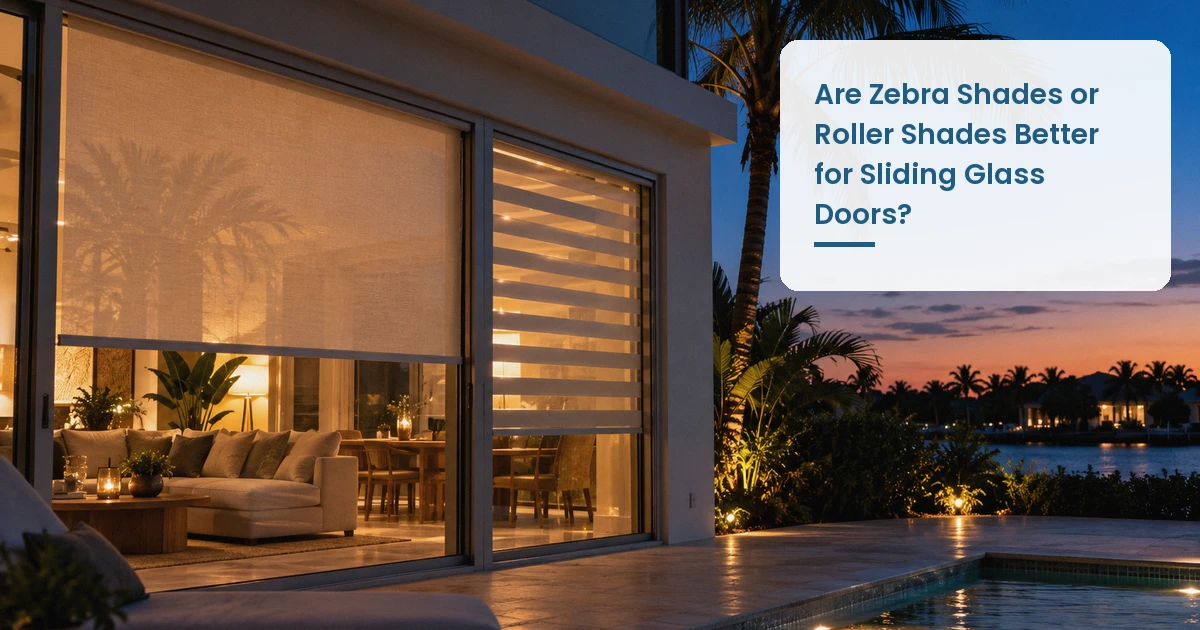
Are Zebra Shades or Roller Shades Better for Sliding Glass Doors?
A wide slider changes the math again. Ever tried to line up a shade with a door track that gets used five or six times a day?
Both zebra and roller shades can be sized for large openings up to 12 feet wide or more, but they behave differently in daily use.
- Roller shades: simpler mechanism, fewer moving parts to misalign over years of daily use
- Zebra shades: more visual interest, but the layered fabric needs slightly more care when sizing a very wide opening
- Motorized versions of either exist, which helps on doors used constantly
A Miami Shores home with a pool-facing slider often leans toward roller shades for exactly this reason. Zebra shades still work there, and they’re a fine fit on a door that’s opened only a couple of times a day rather than constantly.
Can You Mix Zebra Shades and Roller Shades in the Same Home?
Absolutely, and it’s common in South Florida homes with a mix of bright and shaded rooms. Why force one shade type onto every window when rooms don’t share the same light?
A typical mix across 5 or 6 windows might look like this:
- Zebra shades in a home office or living room for adjustable daytime privacy
- Blackout roller shades in bedrooms for full darkness at night
- Solar roller shades in a sunroom or kitchen for glare control
- Motorized roller shades on a hard-to-reach window or skylight
Your consultant can help coordinate colors and fabrics so the mix reads as intentional. See our full roller shades selection for fabric options, and our zebra shades selection for band colors and patterns.
Related Service: Want to see both shade types side by side before deciding? Talk to our design team
Final Thoughts
Zebra shades and roller shades both solve the glare and privacy problem, from different angles. Zebra shades give you continuous, adjustable light control from one shade. Roller shades keep things simple, with fabric choice doing most of the work. Neither is the wrong pick. It comes down to how much daily adjustment you want versus how much simplicity you’d rather have.
Why does that distinction matter beyond comfort? Because the wrong shade for a bright room means squinting at a screen or living with a dark room during the day, in Miami and across the United States alike.
Walk through your home and think about which rooms change the most from morning to afternoon, and which ones you’d rather set once and forget. That’s where the choice matters most.
Palace Interior Design, Inc. has built and installed zebra shades and roller shades across Miami-Dade, Broward, and Palm Beach Counties for more than two decades.
Ready to compare fabric samples of both in your own home? Schedule your free in-home consultation or call 1 (866) 488-7205. You can also browse our full product range before your visit.