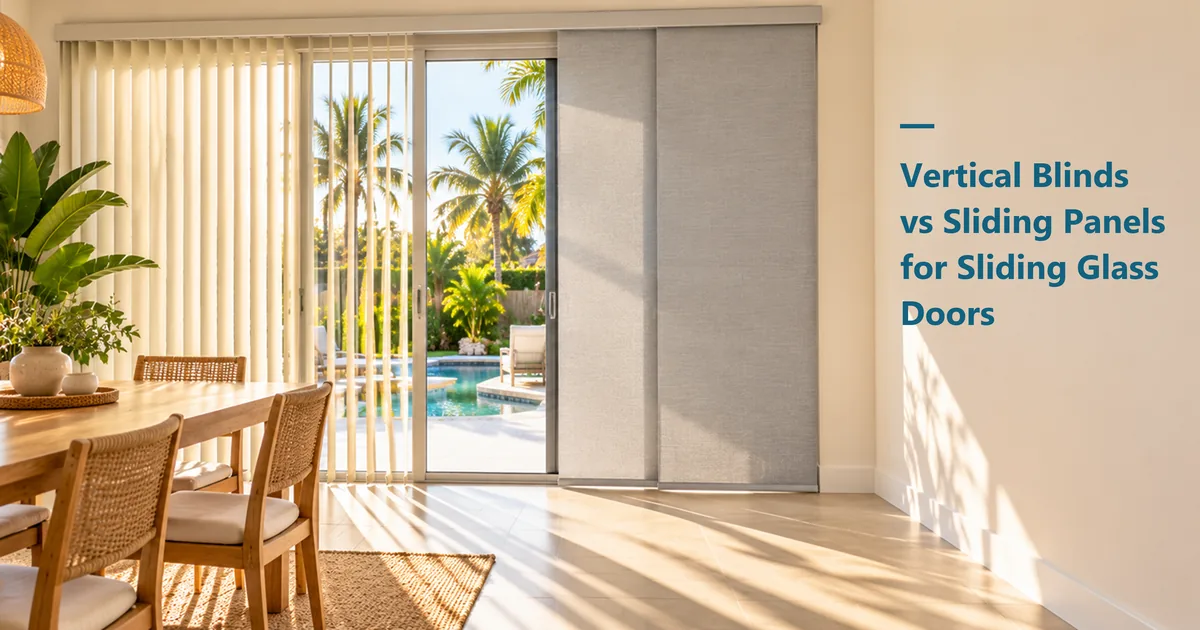
Vertical blinds use individual fabric or vinyl vanes that tilt and stack to one side, while sliding panels use wide fabric panels that glide along a track like a sliding door. In Miami, vertical blinds give more precise light control, while sliding panels offer a cleaner, more modern look for very wide openings. Palace Interior Design, Inc. builds both across South Florida.
Key Takeaways
- Vertical blinds use narrow vanes you tilt for light control, while sliding panels use wide fabric sections you slide open and closed.
- Vertical blinds suit standard-to-large sliders, while sliding panels tend to favor very wide openings of 8 feet or more.
- Panel track systems typically use 2 to 6 panels, depending on the width of your door.
- Both stack to one side, but sliding panels leave a cleaner, less segmented look when fully open.
- Neither is wrong for a slider. The choice usually comes down to opening width and the look you want.
A Kendall family with a 10-foot sliding glass door leading to the pool faces the same question every time: do you go with something that tilts for precise control, or something that glides open in one clean motion? That’s the vertical blinds versus sliding panels decision in a nutshell.
Both cover wide openings well. Both stack out of the way when you want full access to the door. But they work differently, and the width of your slider often points you toward one over the other before style even enters the conversation.
We’ll walk through how each one operates, where each performs best, and which openings tend to favor one over the other. If you haven’t settled on blinds, shades, or shutters in general yet, our guide to blinds vs shades vs shutters covers that broader comparison first.
Let’s start with how vertical blinds work.
What’s the difference between vertical blinds and sliding panels?
Vertical blinds are made of individual slats, called vanes, that hang from a headrail and tilt open or closed with a wand or cord. Sliding panels are wide fabric panels, often called panel track blinds, that glide along a track system similar to a closet door. Both are built for sliding glass doors and wide windows, but vertical blinds offer finer light adjustment, while sliding panels give a flatter, more contemporary look.
How Do Vertical Blinds Work on a Sliding Door?
Ever tilted a vertical blind vane to let in light without anyone seeing straight into your living room? That’s the main advantage in one motion.
Vertical blinds are made of individual vanes, usually 3.5 inches wide, connected by a chain at the bottom and hung from a headrail. A wand or cord tilts the vanes for light control, and a separate cord draws the whole stack to one side.
- Fabric vanes: softer look, wide color range
- Vinyl vanes: moisture-resistant, budget-friendly
- Faux wood vanes: a heavier, more rigid option for larger doors
In a Fort Lauderdale condo with a pool-facing slider, vertical blinds are a common pick because they stack neatly to one side and don’t block the walkway when fully open. Most vertical blind systems handle openings up to about 12 feet before a second headrail section is needed.
Are vertical blinds good for a wide sliding glass door?
Vertical blinds work well on wide sliding doors, especially up to about 12 feet, since the vanes tilt independently for precise light control and stack compactly to one side. For doors wider than that, a second track section is sometimes needed to keep the stack manageable. Your consultant can measure your exact opening and confirm whether one continuous headrail will cover it.
|
Let’s Talk Strategy: Not sure if vertical blinds fit your sliding door width? Talk it through with our team at no cost. |
How Do Sliding Panels Work, and Where Do They Shine?
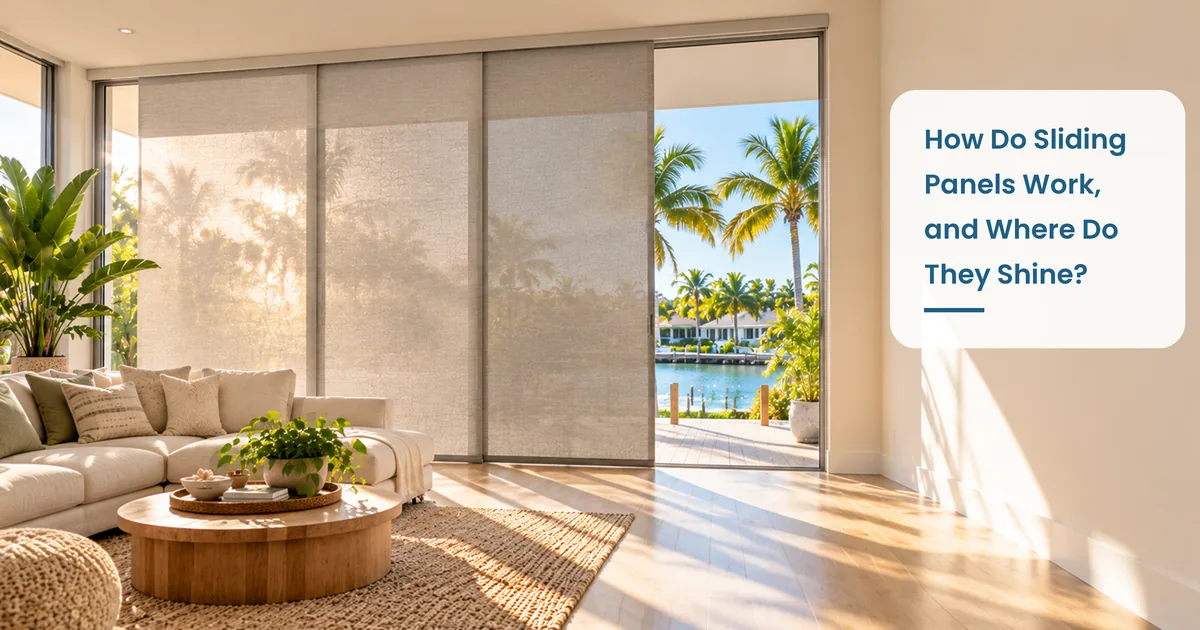
Picture a Weston great room with a 14-foot wall of glass leading to the backyard. A row of narrow vertical vanes can look busy on an opening that wide. That’s where sliding panels take over.
Sliding panels use wide fabric sections, usually 18 to 24 inches each, that glide along an overhead track and stack to one or both sides. Instead of dozens of narrow vanes, a typical door might use just 4 or 5 panels total.
| Panel count | Typical opening width | Best for |
|---|---|---|
| 2-3 panels | Up to 6 feet | Standard sliders, smaller openings |
| 4-5 panels | 8 to 12 feet | Large sliders, double doors |
| 6+ panels | 12 feet or more | Wall-of-glass openings |
That range covers most South Florida sliders without needing custom modifications. A Pembroke Pines home with a 10-foot opening typically lands in the 4-to-5-panel range, which keeps the stack compact on one side.
What is the best window treatment for a very wide sliding door?
Sliding panels are often the stronger pick for very wide openings, since fewer, larger sections stack more compactly than dozens of narrow vanes. Vertical blinds can still cover wide doors but may need a second headrail section past about 12 feet. Your consultant can walk through both systems against your exact door width before you decide.
|
Get a Custom Quote: Tell us your door’s width and we’ll recommend the right system. |
Which Gives Better Light Control, Vertical Blinds or Sliding Panels?
Here’s the question that comes up in nearly every consultation for a sunny slider. Which one actually lets you fine-tune the light?
Vertical blinds win on precision. Since each vane tilts independently, you can angle the whole set to filter light at any degree between fully open and fully closed, without moving the stack itself.
- Vertical blinds: continuous tilt adjustment, fine control over glare at any time of day
- Sliding panels: light level is set mostly by panel position and fabric choice, with less fine-tuning
- For a Doral living room with shifting afternoon sun, that tilt adjustment often matters more than the panel’s clean look
Sliding panels still offer light control through fabric choice, light-filtering versus room-darkening, but once a panel is positioned, there’s no mid-range tilt the way a vertical vane offers.
Read More: Curious how vertical blinds and sliding panels fit into the full lineup of window treatments we build? See our guide to custom window treatments in Miami.
Which Looks More Modern, Vertical Blinds or Sliding Panels?
A Coral Gables homeowner renovating a great room often asks this before anything else. Which one actually looks current?
Sliding panels tend to read as more contemporary, since the wide, flat sections create a clean, uninterrupted look when closed, without the segmented appearance of individual vanes. For an open-concept home where the window treatment is part of the visual statement, that flatness matters.
Vertical blinds aren’t outdated, though. Modern fabric and faux wood vane options have moved past the classic vinyl look, and they remain a practical, budget-friendly choice for 9 or 10-foot doors that don’t need the panel-track treatment.
Which Is Easier to Operate Daily?
A door that gets opened 5 or 6 times a day, every day, puts real wear on any window treatment. So which one holds up better to constant use?
Sliding panels generally have an edge in daily simplicity, since each panel glides along one track with fewer individual moving parts than a full set of vanes and their connecting chain.
- Sliding panels: fewer components, smooth glide, good for high-traffic doors
- Vertical blinds: more components but more granular control, and quality vane connectors hold up well over years of use
- Motorized versions of either system exist, which helps on a door used constantly
A Hollywood, Florida home with a pool-facing slider that’s opened throughout the day often leans toward sliding panels for exactly this reason. Vertical blinds still perform reliably, they just involve more parts working together.
Related Service: Want to compare how each system handles daily use in your own home? Talk to our design team
Can You Mix Vertical Blinds and Sliding Panels in the Same Home?
Absolutely, and it’s a practical approach in homes with sliders of different widths. Why force one system onto every opening when door sizes vary room to room?
A typical South Florida home might mix them like this across 3 or 4 openings:
- Sliding panels on the main living room’s wide, 12-foot opening to the patio
- Vertical blinds on a standard 6-foot bedroom slider
- Vertical blinds on a guest room door where budget matters more than the modern panel look
- Sliding panels on a second wide opening in a Florida room or sunroom
Your consultant can help match fabrics and colors across both systems so the look stays consistent throughout the home. See our full vertical blinds selection for vane styles and colors, and our sliding panels selection for panel-track fabrics.
Read More: Deciding between two other shade types for a bright room? See zebra shades vs roller shades.
Final Thoughts
Vertical blinds and sliding panels both solve the same basic problem, covering a wide sliding glass door without blocking access. Vertical blinds give you finer tilt control and a budget-friendly option for standard-to-large doors. Sliding panels offer a cleaner, more modern look that handles very wide openings with fewer moving parts.
Why does the distinction matter beyond looks? Because the wrong system for a very wide opening means a stack that’s bulky or vanes that need a second headrail section, whether you’re in Miami or anywhere else with a big slider to cover.
Walk through your home and measure your widest sliding door first. That measurement usually points you toward the right system before style even enters the decision.
Palace Interior Design, Inc. has built and installed vertical blinds and sliding panels across Miami-Dade, Broward, and Palm Beach Counties for more than two decades, backed by manufacturer-direct pricing and a lifetime limited warranty on fabric delamination.
Ready to compare both systems against your actual door width? Schedule your free in-home consultation or call 1 (866) 488-7205. You can also browse our full product range before your visit.